Save the Splatter: In Defense of the Recipe Card Nobody Wrote a Blog Post About
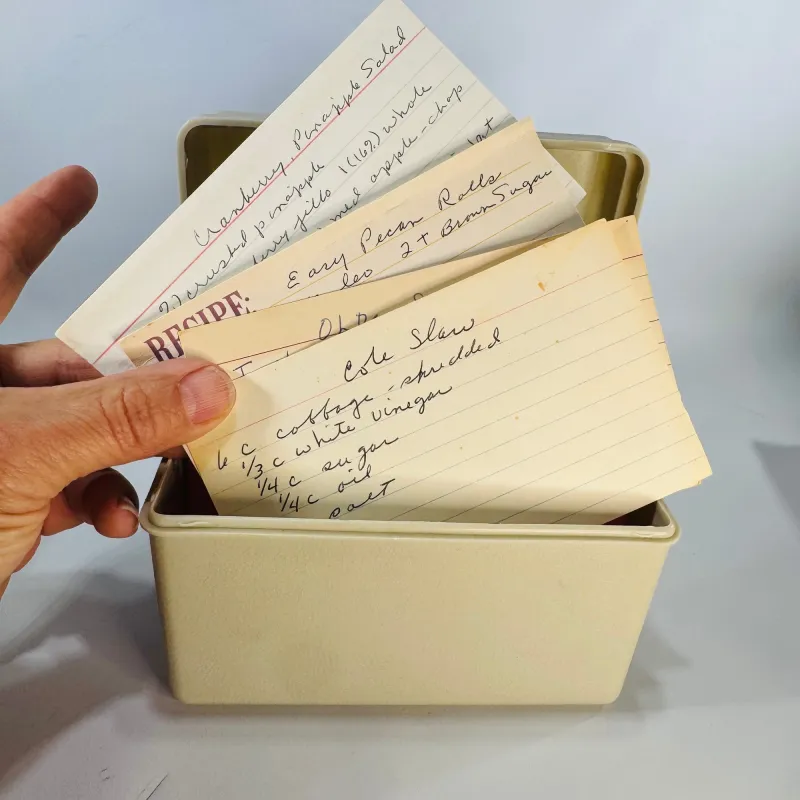
Photo: vintage handwritten recipe card box stained index cards, via myreadingvintage.com
Somewhere in a shoebox in my mother's kitchen there's a card, in my grandmother's slanted cursive, for "Chicken Thing." That's the actual title. Not a casserole, not a bake — Chicken Thing. Below the ingredients, in different ink, someone (my aunt, I'd guess) has written "too much salt!!" and below that, in pencil, my grandmother's rebuttal: "they're wrong."
No food blog on earth could produce that. The internet has a billion recipes, each preceded by 1,500 words about a trip to Tuscany nobody took. What the internet does not have is the marginalia — the arguments, the stains, the evidence of a dish being fought over and adjusted across decades.
I'm here to make the case that the handwritten recipe card is one of America's great unindexed archives. And that we should treat it accordingly.
The Card Is a Document, Not a Download
Consider what a recipe card actually records. Not just the dish, but the cook's circumstances. "Oleomargarine" instead of butter tells you it was written during a rationing era or a lean year. "1 can Campbell's" tells you which decade it was. "Double for church" tells you about the community. "Don't let Ed make this" tells you about Ed.
Substitutions are the best part. Every crossed-out ingredient is a small economic or family history: the year eggs got expensive, the child who was allergic, the husband who hated onions. A food blog gives you the optimized, tested, SEO-friendly version. A card gives you the negotiated version — the recipe as it survived contact with real life.
And the physical wear matters. A splatter stain isn't damage; it's a receipt. It proves the dish was made, repeatedly, by someone who didn't stop to wipe the counter. There's a whole genre of family card that's more stain than paper, and those are usually the best recipes in the box.
Why the Archive Is Disappearing
Here's the problem: recipe cards don't get indexed. They live in shoeboxes, kitchen drawers, and the files of people who will eventually downsize. When a household dissolves — a move, a divorce, a death — the box often goes in the trash, because nobody can tell at a glance that a stained index card is a primary source.
Meanwhile, the recipes that do get saved digitally are the flattened ones: transcribed, cleaned up, stripped of context. "Grandma's cookie recipe" posted to a blog loses the argument about the salt, the note about church, the whole texture of the thing. We're preserving the data and discarding the document.
The Case for the Great American Recipe Card Swap
So here's my modest proposal, and I think it scales from a kitchen table to a church basement: bring back the recipe card swap.
The rules are simple. You hand-copy a recipe that matters to you — actually hand-copy it, because the handwriting is part of the record. You add a note about why it matters, who made it, what went wrong the first time. Then you trade cards with someone else, at a potluck, a library event, a holiday dinner. Repeat annually.
Why does this matter? Three reasons.
First, copying is preservation. When you transcribe a card by hand, you're forced to read every line, ask the questions ("what's a 'gill'?") and carry the recipe forward as a living document rather than a screenshot that dies in your camera roll.
Second, annotation is history. The swap creates new marginalia. Ten years from now, your card will have someone else's pencil note on it — "kids hated the raisins" — and the archive grows another ring, like a tree.
Third, it's a gift economy. Nobody's monetizing a handwritten card. You can't scale it, patent it, or put it behind a paywall. You can only give it, which in our current food-content hellscape is practically a radical act.
Start With the Shoebox
If there's a recipe box in your family, this is your assignment: go find it. Photograph it as backup if you must, but then sit down and actually read it — the notes, the crossed-out lines, the mysterious measurements. Call the person who wrote it if they're still around, and ask about the card. Ask about Chicken Thing.
And then copy one out, in your own handwriting, and give it to someone who isn't a blood relative. Because a recipe that only lives inside one family is a treasure; a recipe that travels between families, picking up notes and stains along the way, becomes something bigger — a piece of the common record, written in cursive, defended in pencil, and absolutely not too much salt.