No Cover Charge, Just a Folding Chair: How America Built Living Rooms Out of Asphalt
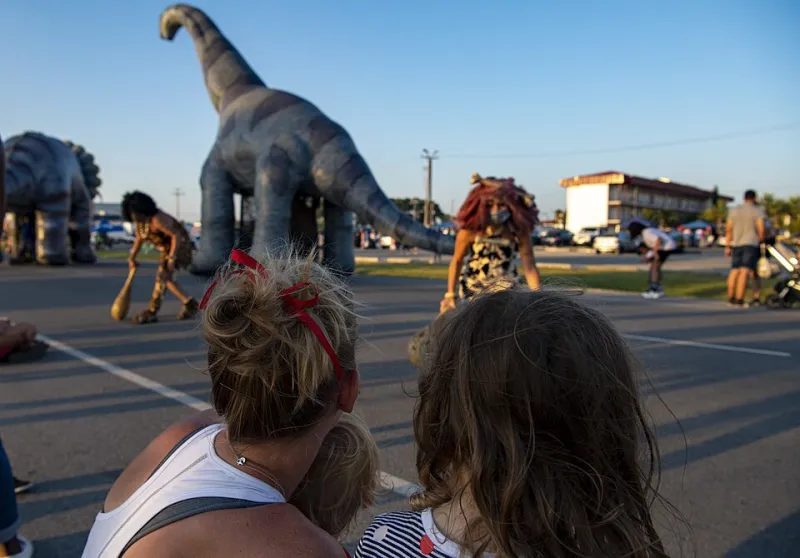
Photo: U.S. Navy photo by Petty Officer 2nd Class Patrick Maher, Public domain, via Wikimedia Commons
There's a moment, usually around 9 a.m. on a fall Saturday, when a stadium parking lot stops being a parking lot. Canopies bloom between pickup trucks. Somebody's cousin is frying brats on a Coleman stove. A stranger hands you a red Solo cup and asks where you're from, and by the time you answer, you've already been invited to play cornhole.
Nobody planned this. There's no reservation system, no guest list, no bouncer checking IDs at the perimeter of Lot C. And yet the tailgate runs on more elaborate social machinery than most restaurants. That's the thing we keep missing when we talk about the decline of American gathering places: we didn't stop gathering. We improvised.
When the Hall Closes, the Asphalt Opens
Sociologists call it the "third place" — the spot that isn't home and isn't work, where community actually happens. Ray Oldenburg, who coined the term, had barbershops and coffeehouses in mind. What he probably didn't picture is a cruise night in a Kmart parking lot outside Toledo, where 200 cars with restored paint jobs and owners who will absolutely explain the carburetor to you line up in rows like a temporary city.
But the pattern is the same. Across the country, the formal venues of communal life — union halls, grange buildings, bowling alleys, the diner that closed in 2019 — have been thinning out for decades. Rent went up, membership went down, and the buildings got turned into condos. What filled the vacuum wasn't an app. It was asphalt.
Tailgates. Trunk sales, where vendors pop their hatches and sell vintage denim out of the back of an SUV. Drive-in movie revivals. Flea market aisles under highway overpasses. These are not destinations anyone built on purpose. They're spaces that get claimed, week after week, by people who need somewhere to be together.
The Unwritten Constitution of the Parking Lot
Spend enough time at these gatherings and you realize they run on a code — never written down, but enforced ruthlessly.
You bring enough to share. Tailgate rule number one. Nobody's doing the math on whether you've contributed equally, but show up empty-handed twice and people notice. The grill is communal. The lawn chairs migrate. Someone's uncle will hand you a plate you didn't ask for.
The canopy is the border. At a trunk sale or tailgate, an open hatchback or popped tent is an invitation. A closed one is privacy. Everyone understands this without a single sign being posted. It's a level of legible social signaling that no app notification has ever matched.
You talk to whoever's next to you. At a bar, conversation is a negotiation. At a cruise night, the guy who owns the '69 Chevelle will tell you everything, whether you asked or not, and somewhere in the third paragraph about the engine block, you realize you've made a friend.
Cleanup is collective. Watch the end of any tailgate. Trash bags appear from multiple directions. Nobody assigns this. The lot has to be cleaner than they found it — because the whole arrangement depends on the lot being there next week.
Belonging Without a Membership Fee
Here's what these improvised spaces reveal, if you squint: the hunger for community never went away. What went away was affordable places to satisfy it.
A night out for two at a decent restaurant can run $100 now. A bar tab isn't much better. But a tailgate costs the price of a bag of chips and a bag of ice. A flea market table costs $20. A parking lot, famously, is free. These gatherings are, in part, a workaround — a way to have a social life on a budget that assumes you're also paying rent.
But it's more than economics. There's a particular kind of belonging that only happens in temporary spaces. Because the community assembles and dissolves in a single afternoon, nobody's keeping score. Nobody knows your job title or your credit score. You're just the person with the good chili, or the person who knew that song, or the person who helped flip the table at the end. Identity gets rebuilt from scratch every weekend, and for a lot of people, that's a relief.
What We Should Learn From the Lot
Cities are starting to catch on, slowly. Some have experimented with "open streets" days that turn pavement into plaza. Parking reform advocates point out that we dedicate more land to storing cars than to housing people — and that some of that land could, for a few hours a week, store community instead.
But the tailgaters and the trunk-sale vendors would tell you the truth: you can't program this. You can only permit it. The gathering happens because someone showed up with a grill and a friendly attitude, and someone else showed up hungry, and the space between them was unregulated enough for a conversation to happen.
That's the real lesson of America's improvised living rooms. Community isn't a venue you book. It's a habit you practice. And sometimes all it takes is a folding chair, a folding table, and a patch of asphalt that nobody's using — yet.