Nowhere to Be: How Aimless Outings Became the Most Radical Thing Young Americans Are Doing
The Drive That Goes Nowhere on Purpose
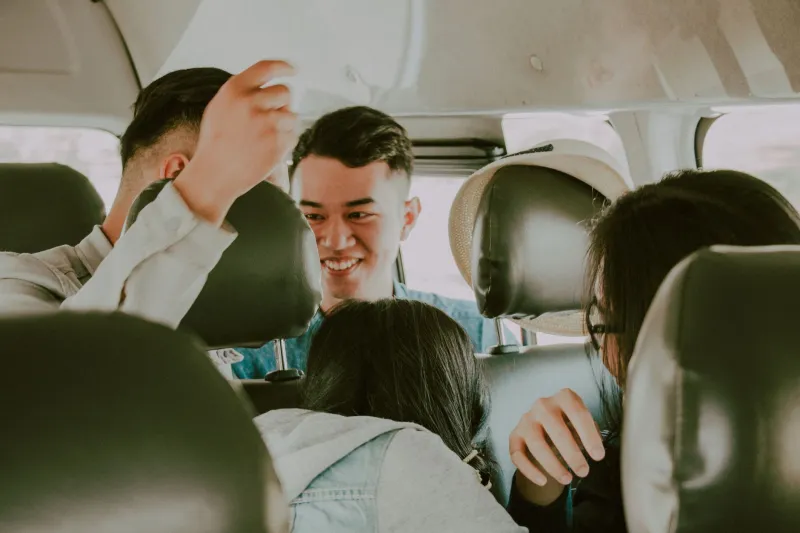
Last spring, a group of friends in Phoenix started doing something they called "the loop." No destination. No podcast. No errand at the end of it. Just four people in a car, driving the same stretch of surface roads they'd driven a hundred times before, talking about nothing in particular until someone said they were hungry and they stopped somewhere random.
They've done it almost every weekend since.
"People ask us where we're going and we say 'nowhere' and they look at us like we've lost it," says one of them, a 26-year-old named Jordan. "But honestly it's the most relaxed I feel all week. There's no agenda. Nobody's checking their phone to see if we're on schedule. We're just... out."
Across the country, in cities and suburbs and small towns, something similar is happening. Young Americans — a demographic that has been sold on the gospel of optimization since childhood — are quietly, deliberately, choosing to do nothing. Together. On purpose.
The Productivity Hangover
To understand why aimlessness feels radical right now, you have to understand what it's reacting against.
Millennials and Gen Z came of age in an era that treated time as a resource to be maximized. Hustle culture told you that every free hour was a failure of ambition. Social media turned hobbies into side hustles and side hustles into brands. Even leisure was supposed to be legible — the workout with the tracked metrics, the trip with the aesthetic photos, the reading goal logged in an app.
The result, for a lot of people, was exhaustion. Not just physical exhaustion, but something more structural — a deep tiredness with the premise that everything you do needs to be justified by its output.
The aimless outing is a direct response to that premise. It doesn't produce anything. It doesn't optimize anything. It doesn't even make for a particularly good story afterward. It just happens, and then it's over, and somehow that's the whole point.
The Mall Walk as Protest
Think about the American mall for a second. As a retail destination, it's been in slow decline for decades. But as a place to walk around, sit on a bench, get a pretzel, and watch people — it's been quietly thriving.
Across the country, malls have become default gathering spots for teenagers and young adults who aren't there to shop. They're there to exist somewhere that isn't home, somewhere that has ambient life and air conditioning and the low hum of other people going about their business.
This is not a new behavior. Mall culture was always partly about hanging out. But there's something newly intentional about it now — a conscious choice to be somewhere without having a reason to be there, as a kind of low-grade defiance.
"I go to the mall with my friends sometimes and we genuinely don't buy anything," says Keisha, a 23-year-old in Charlotte. "We walk around, we try on stuff we're not going to get, we split a Auntie Anne's. We're there for like three hours. And it feels weirdly good? Like we're getting away with something."
What they're getting away with, arguably, is the right to occupy space without consuming. In an economy that increasingly defines your presence by your transaction, just being somewhere without buying anything is a minor act of resistance.
Doing Nothing Together Is Actually Doing Something
Here's what the productivity framework misses about aimless time: it's not empty. It's full of something that structured activities tend to crowd out.
When you have nowhere to be and nothing to accomplish, conversation goes different places. You're not catching up on logistics or making plans or debriefing a shared experience. You're just talking — following threads wherever they go, doubling back, sitting in silence when there's nothing to say, noticing things out the window.
This is the texture of old friendship. It's what hanging out used to mean before hanging out became a calendar event with an agenda.
Research on social bonding consistently finds that shared time — not shared activities, not shared goals, just time — is one of the primary mechanisms through which closeness develops. The content of the time matters less than people assume. What matters is the accumulation of unguarded moments, the kind that only happen when nobody's performing.
The directionless drive, the aimless walk, the afternoon that somehow becomes an evening — these are the conditions under which people actually get to know each other. Not the dinner with the reservation, but the two hours driving around afterward because nobody wanted to go home yet.
The Countercultural Hang
There's a reason this feels countercultural even though it's one of the oldest human behaviors there is. We've built an entire infrastructure of optimization around leisure. Apps to find the best route. Reviews to identify the best restaurant. Itineraries for the best use of a free afternoon.
Choosing to ignore that infrastructure — to get in the car without a destination, to walk into a park without a trail goal, to show up at a friend's house with no plan — requires overriding a lot of trained behavior. It requires tolerating uncertainty and inefficiency and the mild anxiety of not knowing how the time will be spent.
For a lot of people, that tolerance is a skill they've had to relearn. The ease of unstructured time is something they remember from childhood and have been slowly trained out of.
"I used to feel guilty if I spent a whole afternoon just hanging out," admits Jordan. "Like I should have been doing something. Now I think the hanging out is the something."
The Common Thread in the Aimless Afternoon
What makes this moment interesting from a community perspective is that the aimless outing is, at its core, an act of prioritizing presence over productivity. It says: I would rather be with you than accomplish something. It says: your company is the point, not the destination.
In a culture that has commodified almost every form of togetherness — the experience economy, the curated event, the ticketed activation — choosing to just exist together in a parking lot or a mall or on a country road is a genuinely radical act of community.
The common thread here isn't a shared interest or a shared identity. It's shared time, freely given, without expectation of return.
That might sound like nothing. But right now, it might be one of the most important things we've got.