Coffee's Getting Cold and Nobody Minds: The Stubborn Survival of the American Diner
The Bell Above the Door Still Means Something
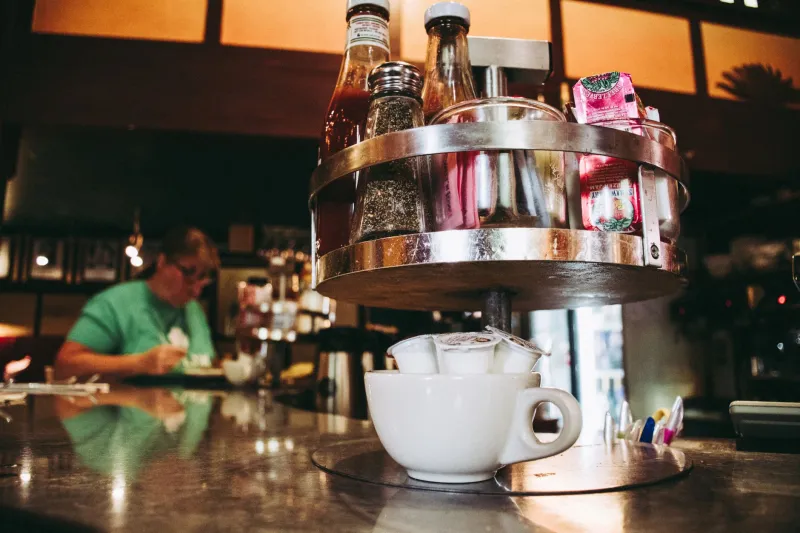
Walk into Lou's Family Restaurant on a Tuesday morning in Akron, Ohio, and you will encounter several things in rapid succession: the smell of bacon grease and fresh coffee, the sound of at least three overlapping conversations, and the distinct sensation that you have stepped slightly outside of regular time.
Lou's has been here since 1974. The booths are a particular shade of burgundy that doesn't exist anywhere else in the known universe. The laminated menus have been reprinted maybe twice. And every morning, without fail, the same rotation of regulars occupies the same stools at the same counter, doing what humans have always done when they gather in a shared space: talking, complaining, laughing, and occasionally solving the world's problems between bites of wheat toast.
"I've been coming here for thirty-one years," says Gerald, 68, a retired steelworker who arrives at 7:15 every weekday without exception. "I know everybody's name. I know their kids' names. I was at three funerals last year for people I met right here at this counter. You can't get that from DoorDash."
No, Gerald. You really cannot.
What the Algorithm Can't Replicate
There is something almost radical, in 2024, about a place that doesn't ask for your email address. The neighborhood diner — and its cultural cousins, the local barbershop, the corner laundromat, the neighborhood bar — operates on a fundamentally different logic than the digital infrastructure that increasingly mediates American social life.
There is no engagement metric here. No sponsored content. The only recommendation engine is Shirley, the morning shift waitress who has been at Lou's for nineteen years and will tell you, without being asked, that the French toast is better than the pancakes on Tuesdays because that's when they get the fresh bread delivery.
This is what sociologists sometimes call a "third place" — not home, not work, but somewhere in between. A space that belongs to the community rather than to any individual or corporation. Ray Oldenburg, the urban sociologist who popularized the concept back in the eighties, argued that these spaces are essential to democratic life. Without them, communities fragment. People retreat into their separate silos and stop encountering each other by accident.
Accidental encounters. That's the thing. That's what we keep losing, and what places like Lou's stubbornly refuse to let go of.
Intergenerational Wi-Fi
One of the most quietly extraordinary things about these neighborhood anchors is the way they scramble the usual social sorting mechanisms. In a world that is increasingly age-segregated — where young people and old people occupy almost entirely different cultural universes — the corner diner is one of the last places where a 22-year-old and a 70-year-old might sit next to each other and actually talk.
Demi, 24, a graduate student who started coming to Lou's because it was close to her apartment and the coffee was cheap, describes a friendship she struck up with a regular named Earl that she genuinely didn't expect.
"He's in his mid-seventies, retired, widower. We have basically nothing in common on paper," she says. "But we started chatting one morning when all the seats were taken and I asked if I could sit at his table. Now we talk every time I come in. He told me about what this neighborhood looked like in the seventies. I told him about my research. Last month he brought me a book he thought I'd like." She pauses. "Where else does that happen? Like, genuinely, where?"
It's a fair question. The platforms that now govern so much of our social lives are extraordinarily good at connecting us with people who are already like us. They optimize for similarity. The diner optimizes for proximity, which is a different thing entirely — and, it turns out, a surprisingly generative one.
The Owners Are Holding the Line
None of this happens without the people who choose, against considerable economic pressure, to keep these places open.
Running an independent diner in America right now is not for the faint of heart. Food costs are up. Labor is harder to find and retain. Every third customer has a dietary restriction that didn't exist as a category ten years ago. The big chains have the marketing budgets and the supply chain advantages. And yet.
Maria, who has owned a breakfast spot in East Nashville for eleven years, says she has been approached twice by developers who wanted to buy her out. She declined both times.
"People think I'm being sentimental," she says, refilling a coffee cup without being asked, because that's just what you do. "But it's not sentiment. It's that I watch what happens in here every single morning. I watch people come in alone and leave feeling less alone. I watch people get news — good news, bad news — and have someone right there to share it with. I'm not going to put a price on that."
She's not naive about the economics. She does a brisk weekend brunch business that subsidizes the quieter weekday mornings. She's on Instagram, because she has to be. But she's adamant that the soul of the place lives in the counter, not the content calendar.
The Irreplaceable Chance Encounter
Here at The Common Thread, we spend a lot of time thinking about the infrastructure of community — the invisible scaffolding that holds neighborhoods and movements and cultures together. And what keeps coming up, in conversation after conversation, is the importance of spaces that aren't designed for any particular purpose.
The diner doesn't ask you to be productive. It doesn't have a stated mission. It's just a place where people show up and, by virtue of showing up in the same physical space, become part of something larger than themselves.
In a country that is deeply, painfully divided along almost every available axis, there is something worth protecting about a place where the guy with the MAGA hat and the woman with the "Protect Trans Kids" sticker on her laptop both come for the same eggs Benedict and have been nodding hello to each other for six years. Nobody's changing anybody's mind over breakfast. But they're also not pretending the other person doesn't exist. That's not nothing. That might actually be something.
The coffee's always a little too hot when it arrives and a little too cold by the time you finish your conversation. And somehow, that's exactly right.
Lou's opens at six. Gerald's already there.